
Here is the thing nobody tells you about European Christmas markets: the markets themselves are the easy part. Turning up is easy. What separates your magical week from an expensive, footsore blur is which markets you pick, when you go, and how many you attempt before the Glühwein stops tasting festive and starts tasting like a chore.


This is the planning guide: dates, budgets, how to string cities together, what to wear when you are standing still in the cold for four hours, and how many markets is genuinely too many. We have done these on foot, by train and by river, and made most of the mistakes so you do not have to.
Plan Your Christmas Markets Trip at a Glance
| Question | The short answer |
|---|---|
| When do markets open? | Late November to 23–24 December. Most close before Christmas Day. |
| Best time to go | First two weeks of December, midweek, after 4pm. |
| How many cities? | Three in a week. Four is pushing it. Five is a blur. |
| Budget per day | €120–180 pp including a mid-range hotel, food and a couple of Glühwein. |
| Getting around | Trains. Almost every market city is 2–4 hours from the next. |
| Biggest mistake | Arriving on 24 December and finding the stalls being dismantled. |
| ⭐ BuKoo Rating | ⭐⭐⭐⭐⭐ (5 out of 5) |
| 🔥 BuKoo Verdict | A bucket-list must-do |
When to Go — and the Date Trap
Most European Christmas markets run from the Friday before the first Advent Sunday until 23 or 24 December. That last detail catches people out every single year: if you have booked a trip for Christmas, you may arrive to find the stalls already coming down. Christmas Day and Boxing Day are the quietest days of the entire European calendar — shops shut, restaurants closed, markets gone.
Any exceptions? Vienna and Budapest keep some markets running to New Year, and a few Advent markets reopen for Epiphany in early January. Strasbourg, Nuremberg and Cologne all finish before Christmas Eve, so check before you book.
So when should you actually go? The first fortnight of December, midweek. Late November is quieter still, but some stalls will not be fully open, and weekends from 6 December onward are shoulder-to-shoulder — in Cologne and Strasbourg, uncomfortably so.
🐧 BuKoo Tip: Markets are an evening activity — they look their best from about 4pm when it goes dark, and the same square is flat and half-empty at 11am. Plan your museums, castles and thermal baths for daylight and save the markets for dusk. In December you only get about eight hours of daylight, so this is easier than it sounds.
Which Markets, and Who They Suit
Ten markets worth building a trip around — matched to what you actually want out of the week.
Market | Best for | Book |
|---|---|---|
Strasbourg, France | The full storybook: oldest market in France, eleven squares, cathedral lit above it | |
Nuremberg, Germany | Tradition and food — protected gingerbread, no plastic, the Christkind opening | |
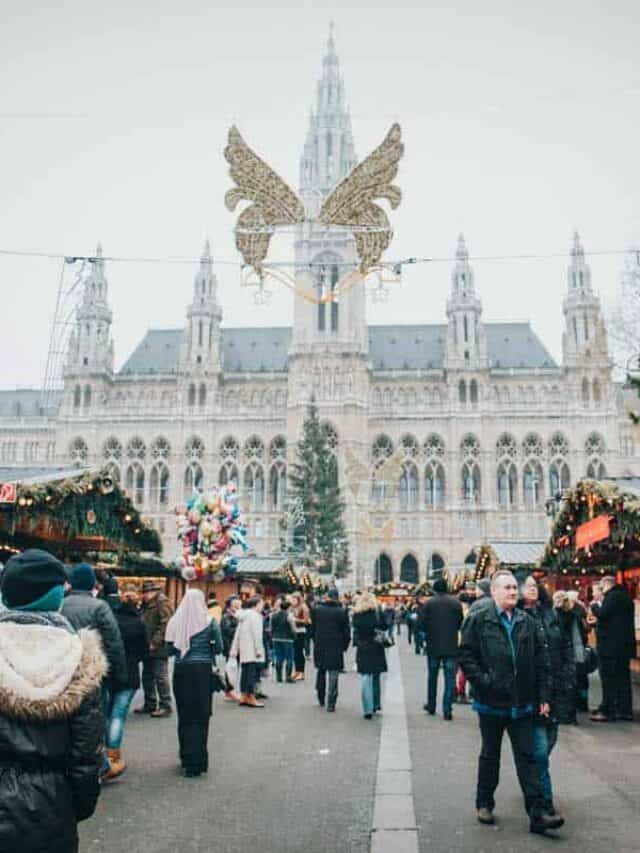
Vienna, Austria | Elegance — palace forecourts, skating paths, and an orchestra nearby | |
Colmar, France | Small-town charm and canals; the prettiest per square metre | |
Prague, Czechia | Value — the cheapest of the big-name markets by a distance | |
Budapest, Hungary | Eating properly, then a thermal bath afterwards | |
Cologne, Germany | Efficiency — seven markets walkable in one afternoon | |
Munich, Germany | Bavarian classicism and Feuerzangenbowle | |
Copenhagen, Denmark | Atmosphere after dark — Tivoli under a million lights | |
Basel, Switzerland | The underrated one, and a springboard into Alsace |
For a fuller description of each — what to eat, which square to head for first — see our companion piece on the best Christmas markets in Europe.

Three Routes That Actually Work
Which cluster is yours? Markets cluster tightly, so the trick is picking one rather than criss-crossing the continent. Each of these is comfortable in seven to nine days.
1. The Rhine & Alsace — the classic
Strasbourg → Colmar → Basel → Cologne. The densest concentration of good markets in Europe, all on one rail spine. Strasbourg and Colmar are 30 minutes apart, Basel is an hour further, and Cologne is your long hop north. This is also the route most river cruises follow, worth considering if you would rather unpack once — our Rhine Christmas market cruise review covers what that is actually like.
Where to stay: Strasbourg · Colmar · Basel · Cologne.
2. Central Europe — the value route
Prague → Dresden → Vienna → Budapest. The best-value week of the three by a wide margin: Prague and Budapest will cost you markedly less for beds and food than anywhere in Germany or Austria, and the rail links are direct. Take Dresden as a day trip from Prague rather than an overnight — its Striezelmarkt is Germany’s oldest and you can do it in a day and be back for dinner.
Where to stay: Prague · Vienna · Budapest.
3. Bavaria & Bohemia — the short break
Munich → Nuremberg → Prague. Under two hours between each, which makes this the best option if you only have four or five days. Munich for the Bavarian spectacle, Nuremberg for the food and tradition, Prague for value and the prettiest square of the three.
Where to stay: Munich · Nuremberg.
What It Costs
What will it cost you? Christmas market cities run at peak winter rates — this is high season, not a shoulder-month bargain. Rough per-person daily costs, mid-range:
Germany / Austria / Switzerland | Czechia / Hungary | |
|---|---|---|
Hotel (per room) | €140–220 | €70–120 |
Glühwein | €4–6 plus €3–5 mug deposit | €2.50–4 |
Market meal | €8–14 | €5–9 |
Guided market tour | €25–45 | €20–35 |
Train to next city | €25–60 booked ahead | €15–35 |
Realistic daily total | €150–200 | €90–130 |
Book your beds first, everything else second. Hotel prices in Strasbourg, Colmar and Nuremberg climb steeply from about eight weeks out and the best-located places go first. Trains booked in advance cost you a fraction of the walk-up fare.
How Many Markets Is Too Many
Three cities in a week is the number we keep coming back to. Two nights each gives you one full evening at the markets and one day to see the city in daylight, with a half-day of travel between. Four cities means you are packing every other morning. Five means you will remember the stations better than the squares.
Why go slower? Because the markets are more alike than the brochures suggest, and the stalls sell broadly similar things. What differs is the setting — a cathedral, a palace, a canal, a medieval square — and you will appreciate that far more at one every two days than at two a day.
⭐ BuKoo Quick Picks
💑 Best for a couple’s long weekend: Colmar. Small enough to walk end to end, pretty enough that you will not stop taking photographs, and close enough to Strasbourg to do both.
💶 Best value: Prague, with a Dresden day trip. Two of Europe’s great markets, one of them Germany’s oldest, on Czech prices.
🍽️ Best if you are going to eat your way round: Budapest. The only market city where the food is vetted and genuinely good rather than merely seasonal.
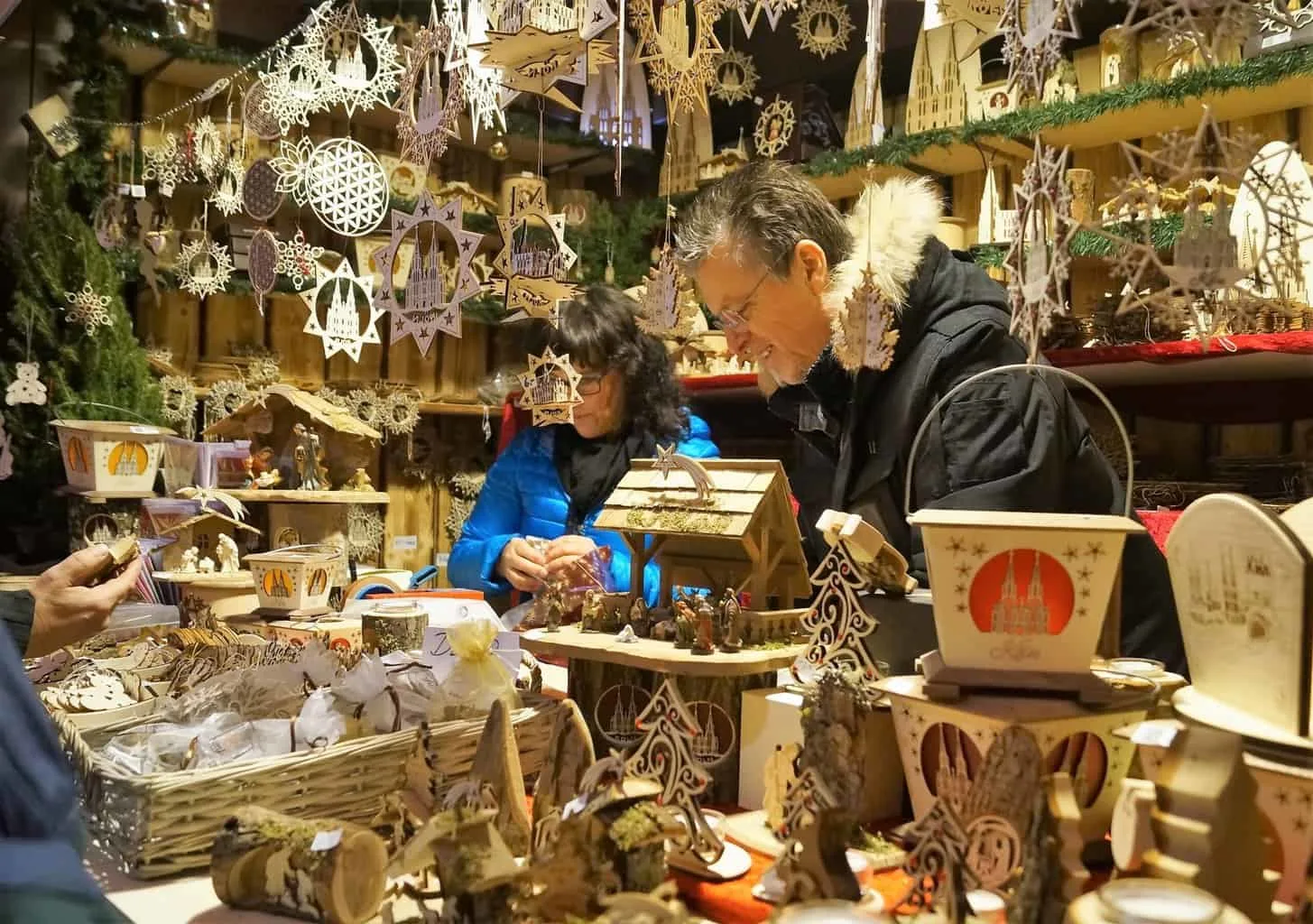
🎁 The one thing worth buying: a hand-carved nativity figure from Munich’s Kripperlmarkt, or a Nuremberg Zwetschgenmännle — a little figure made of dried plums. Both are actually local; most of what you will be offered is not.
Good to Bring
Market evenings are a specific kind of cold: you are outdoors, standing still, for hours, often on wet cobbles. Dress for that rather than for walking.
- Sheepskin wool insoles — the single best thing on this list. Cold comes up through the stones.
- Touchscreen thermal gloves — you will be paying, photographing and holding a hot mug, often at once.
- Rechargeable hand warmers — they double as a phone power bank, which matters in the cold.
- A merino base layer set — thin, warm, and it does not smell after three days of Glühwein.
- A merino quarter-zip — the mid-layer that works indoors as well as out.
- An anti-theft crossbody bag — markets are exactly the crowded, distracted setting pickpockets prefer.
- A packable tote — for everything you did not plan to buy.
Our full European winter packing guide goes deeper on layering if you are travelling for longer than a week.
Nine Things Worth Knowing Before You Go
1. Bring cash. Plenty of stalls in Germany and Austria still do not take cards.
2. The mug is a deposit. Your Glühwein comes with a Pfand of €3–5. Hand the mug back and you get it returned — or keep it. Every city has its own design and year stamp.
3. Markets close before Christmas. Say it twice. 23 or 24 December for most.
4. Go midweek. Saturday evening in Cologne is not a pleasant experience.
5. Book trains early. Advance fares are often a third of the walk-up price.
6. Eat at the market, not around it. Restaurant kitchens near the squares are overwhelmed in December, and the stalls are the better meal anyway.
7. Watch your bag. Dense, distracted crowds in the dark — the classic setting.
8. Check the official dates each year. They shift with Advent, so last year’s dates are not this year’s.
9. One market per evening. Two is how you stop enjoying them.
Keep Exploring
- The best Christmas markets in Europe — the market-by-market companion to this guide.
- A Rhine Christmas market river cruise — six markets, one unpacking.
- Things to do in Vienna in winter — for your daylight hours.
- 21 unique things to do in Europe in winter — beyond the markets entirely.
- What to pack for a European winter.
- Best winter road trips in Europe — the driving alternative.